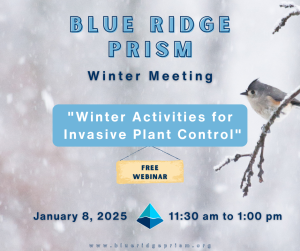
 Winter is a good time to attack many invasive plants, and in fact, that’s the focus of the upcoming Winter Meeting of Blue Ridge PRISM. You won’t want to miss this free webinar on January 8, 2025, 11:30 am–1:00 pm on Zoom. You can submit questions to the panel in advance. Find out more and Register Here.
For winter control activities, the experts at Blue Ridge PRISM advise:
“For many invasive shrubs and vines, we recommend waiting for a warm winter day after a good, soaking rain or snow melt. This is a great time to get outside and work on removing invasive plants as the ground will be soft and many shrubs and vines can be pulled right out. Wineberry, Periwinkle, English Ivy, and Winter Creeper are just a few examples of invasive plants that are ideal for winter removal.”
— “Can I Remove Invasive Plants in the winter?”/Blue Ridge PRISM/Frequently Asked Questions
Autumn olive (Elaeagnus umbellata) is one of the shrubs that can be treated in winter. According to the Blue Ridge PRISM/Autumn Olive Fact Sheet, autumn olive “can be controlled at any time of year, except during spring growth, by cut-stumping or hack & squirting.” For the “cut stump” method, “Cut or saw all stems to several inches from the ground and immediately spray cuts with a concentrated recommended herbicide.” For the hack & squirt method, “Make hacks 2 inches apart in stem circumference and apply concentrated herbicide.” One other method — basal bark — can be employed when the plant is small, with stems of 6 inches or less in diameter. The basal bark method is recommended for the dormant season because it involves spraying or painting herbicide so as to cover all the stems from ground level up to about 10 inches.
Garlic Mustard (Alliaria petiolata) can be treated in winter by pulling, but only in limited situations. To eradicate garlic mustard, understanding its life cycle is key. According to Blue Ridge PRISM,
“garlic mustard is a biennial that completes its entire lifecycle in two growing sea- sons. Its seeds germinate any time from spring to fall. The first-year plants spend the winter as ground-hugging rosettes of evergreen leaves. Second-year plants send up flower stalks in early spring, form seeds in late spring and early summer, then die.
If the soil is moist, you can pull a first-year rosette in winter. But if garlic mustard has gotten well-established on your property, pulling a rosette may bring seeds to the surface, and you’ll have new seedlings popping up in the area. Another option is to spray herbicide on the evergreen leaves. If you’ve had a garlic mustard problem for several years, you’ll want to follow the guidance found at Blue Ridge PRISM/Garlic Mustard Fact Sheet.
Most invasive vines can be treated during winter with the cut stump method. However, for Japanese honeysuckle, choose a warm day in winter to use a foliar herbicide spray on the evergreen leaves.
Check out the PRISM’s recent Weed Alert for all the details on controlling Asiatic bittersweet:
Now is the time to identify and control this invasive vine since it is easy to spot during this time of year. Use our guide to identify Asiatic bittersweet (Celastrus orbiculatus) in the landscape.
Identify and control small infestations before they get too large and harder to control.
Because it can spread so quickly and smother almost anything in its path, Asiatic bittersweet aka Round leaf bittersweet (formerly known as Oriental bittersweet) is rapidly taking over many American forests. As a result, the United States Department of Agriculture considers the Asiatic bittersweet (Celastrus orbiculatus) a national invasive species. Asiatic bittersweet is also listed as a noxious weed in the Commonwealth of Virginia.Act now (when it is easy to spot) to identify and control this invasive species on your property!
………
CONTROL
One of the best ways to combat invasive species is by identifying small infestations and removing them before they grow larger and harder to control. To ensure long-term control of Asiatic bittersweet, monitor treated sites for several years for seedlings and root regrowth. Treat these as soon as possible.
Manual: Seedlings are easiest to remove when the soil is moist and the population is small. Pull steadily and slowly to minimize soil disturbance and tamp down the soil afterwards; make sure to remove the crown and all large roots. In small infestations, larger plants can also be removed by digging if care is taken to remove all roots.
Do not pull vines from trees; this is hazardous to people on the ground and can damage the trees.Cut Stump: Cut small to large vines near ground level using a hand pruner, hand-saw, or chainsaw. Immediately apply a concentrated herbicide such as glyphosate to the cut stump to prevent re-sprouting. This can be done from June through February (before sap starts flowing upwards in the early spring).
If you’d like to receive these Weed Alerts via email, sign up here.
For all herbicide recommendations, the Blue RIDGE PRISM relies upon the Virginia Department of Forestry’s “Non-Native Invasive Plant Species Control Treatments: Timing, Methods and Herbicide Rates,” Control Methods/Blue Ridge PRISM.
You’ll want to check out a new feature on the website of Blue Ridge PRISM: Virginia Invasive Plant ID & Control Tool, which is an easy-to-use chart which contains photos, videos, and control information for a large number of invasive plants.
Featured Photo: garlic mustard rosette by Cathy Caldwell