I recently read the 2022 book What Your Food Ate, by geologist David Montgomery and biologist Anne Biklé. The authors have published two other books: The Hidden Half of Nature and Dirt: The Erosion of Civilizations, which also deal with the issues of soil health, microbiomes and farming practices.
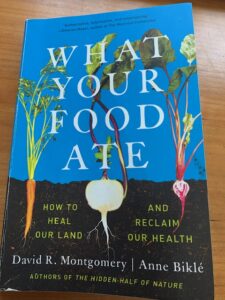
What Your Food Ate provides science-based insight into how soil health and farming practices directly impact plant health and nutritional content which in turn affect the health of the animals and humans that consume them. This article summarizes the key points the authors present.
Agricultural Practices and Soil Health
The book opens with a discussion of how farming techniques have evolved from pre-industrial natural methods to mechanized agricultural practices including heavy tilling and the use of chemical fertilizers, pesticides and weed killers on large crop monocultures. It makes the point that dramatic human population growth over the past 150 years demanded a major increase in food output. This coincided with technological changes, leading to the shift in agricultural practices. While the changes achieved the increased output objective, they also generated an unplanned and, for a long time, unrecognized degradation of soil health, that caused a reduction in the nutritional content of crops. Because the chemical fertilizers lack many micronutrients that are central to plant health and the nutritional content of food produced, their use along with mechanized farming practices has led to a major reduction in soil health and plant-available nutrition.
The analysis compares the content of conventionally grown to regeneratively grown crops where the regenerative process includes basic organic practices (adding organic matter and minimizing chemical use), plus the regenerative additions of no-till, cover cropping, crop rotation and crop diversity. While conventional practices utilizing chemical fertilizers give plants the macronutrients needed to grow, they omit many micronutrients needed for plant health, making them more susceptible to insect and disease damage while reducing their nutritional content. In addition, not replacing organic matter depletes soil microbial and fungal life that make the nutrients in soil accessible to plants. This makes plants increasingly dependent on chemical inputs. Regenerative techniques, on the other hand, are restorative and maintain soil health as nature did, until mechanized, chemically dependent practices were adopted in the early 1900s.
The authors’ position is based on documented research demonstrating that the nutrition content of crops is both higher and broader for regenerative than conventionally grown foods. It also goes into the negative environmental effects of mechanized, chemically based practices, from tilling to erosion and runoff to a reduction of soil life and pollinator populations. It drives home the point that the emphasis on increasing production without regard to soil nutritional content has resulted in significant downstream health impacts.
Soil Content Impacts Plant Health and Nutrition
The authors explain that while conventional practices have been successful at increasing food output, the quality of the food produced has declined. They cite many studies, concluding that plants grown on regenerative test beds and farms consistently demonstrate a more complete range and often higher quantities of needed nutrients. Data also shows that while organically grown crops tend to be of higher nutritional value than conventionally grown, full regenerative practices, that go beyond basic organics, are even better. Test results indicate that following basic organic certification practices including crop rotation, minimal use of approved chemicals and the additional regenerative steps of no-till, cover cropping and plant diversity (vs large monocultures), provides consistently more nutritional results. They explain the importance of organic matter along with microbes and fungi in the soil to make nutrients plant accessible. The discussion provides detailed information about the importance of micronutrients and phytochemicals, in plant, animal and human health and nutrition.
Effects on Animal Health and Nutrition
The animal sections discuss how plant nutrients impact both animal health and the nutritional content of the foods humans derive from them. The foods include meat, fish and dairy products. The authors cite studies comparing the health of animals that are fed processed foods to those that are naturally fed. For example, cattle raised in feedlots and fed processed grains are more at risk of diseases and produce less nutritional meat and dairy products than animals that are pasture fed.
They explain that during the 1950s, we came to believe that animal fats were a prime cause of heart attacks in humans. While initial belief was that all fats tended to raise cholesterol, subsequent study indicates that different types of fat have very different impacts on health. For example, chemical fertilizers generate higher levels of longer-chain omega-6 fatty acids in plants, negatively impacting the health of animal and human consumers while healthier and much needed omega-3s have been reduced. For example, research indicates that beef from cattle fed processed grains in feed lots have a significantly higher amount of omega-6s than omega-3s. It is the opposite for pasture-fed animals. This difference affects both the health of the animals and the health benefits of the meat and dairy products derived from them. The authors link human health declines to the conversion of meat and dairy production to feedlot/processed grain practices.
Human Health Effects
It may be obvious that foods’ nutritional content impacts the health of people who consume them. However, linking the reduced or missing nutrients of conventionally grown plant and animal foods to increases in a variety of diseases, affecting people from infancy to old age, is eye-opening. The link from soil health to plant health to food content is well documented. The many cited studies that measure and compare nutritional content of conventional to regeneratively grown foods make a strong case for tying the positive and negative aspects of soil health and food selection to human health. The authors explain how the outcomes of eating conventionally vs regeneratively produced foods along with the growing consumption of more heavily processed foods has led to the increased occurrence of a multitude of chronic illnesses and diseases including cancers and conditions like obesity.
Take-aways
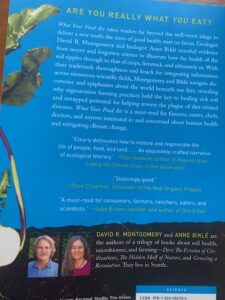
While I was already a believer in the merits of regenerative practices, I found the authors’ connection of soil health to plant health to food nutritional content and animal and human health to be thorough and compelling. It supports the point that regenerative practices are better for all of life on earth, from soil life to plants, animals and humans. It also provides data that demonstrates that the economics of a regenerative approach can be as productive and beneficial for growers as it is for consumers. This reality makes a conversion from conventional agriculture to an equally productive but healthier regenerative approach seem hopeful and realistic.
What Your Food Ate makes a strong argument that the regenerative path is the right one for commercial growers and home gardeners. Given an option in the future, regenerative organically grown foods will be my choice for both gardening and food purchases. For those interested in the basics of regenerative agriculture, I suggest reviewing this information from the Center for Regenerative Agriculture at the University of Missouri.
While regenerative practices are not yet widespread in the agricultural community, they are growing. Let’s hope this growth continues.
Source list for What Your Food Ate from the authors’ website www.dig2grow.com:
https://www.dig2grow.com/_files/ugd/efeec1_9af7d03df12f447f90dee61521c08707.pdf
Book data: What Your Food Ate, by D. Montgomery and A. Bicklé, 380 pages, WW Norton Co., Copyright 2022.