Not your average potato
Mention the word potato, and most people will assume you are referring to the “Irish” potato (Solanum tuberosum). Aptly named the Irish potato, it was introduced to North America by Irish immigrants. However, it originated in South America, and was brought to Europe in the late 16th century. It is part of the Solanaceae or nightshade family.

There’s more to love about sweet potatoes than the orange-fleshed standard.
The sweet potato (Ipomoea batatas), along with the morning glory, is in the bindweed or Convolvulaceae family. It originated in Central and South America, and was tasted by Columbus and his entourage, who eventually took it to Europe in the late 15th century, well before the popular “Irish” potato.
The structures of the two types of potatoes are very different. The sweet potato is actually a root structure, meant as a storage device for carbohydrates and nutrients to be used by the plant when the availability of these are low.
The Irish potato is a tuber, and is an extension of the stem of the plant, not the root. It stores nutrients also, and allows the plant to regrow in better conditions. The development of the “eyes” is an indication the plant is attempting to regrow.
Confusingly, sweet potatoes are often called, and labeled by markets, as yams. Yams (Dioscorea villosa) are very different. They are from the family Dioscoreaceae, which includes lilies and some grasses. Yams originated in Africa, and are, like the Irish potato, an extension of the stem. They can grow to be very large, are very starchy rather than sweet, and have tough, bark-like skin. They are often cooked and mashed into a starchy paste.
Nutrition
Sweet potatoes are a great source of vitamin A (in the form of beta carotene), vitamin B6, vitamin C, potassium, and fiber. Orange flesh sweet potatoes are richest in beta-carotene, while purple sweet potatoes are richer in anthocyanins. Both are phytochemicals celebrated for their role in human health and disease prevention. While their glycemic index and glycemic load is not as high as that of “Irish” potatoes, you’ll still want to enjoy light portions. This is especially important if diabetes is a concern. You can read more about sweet potato nutrition from Harvard University .
Cultivation
Growing your own sweet potatoes is relatively easy, and can be extremely rewarding. They can be grown in the ground, in raised beds, or in large containers.
The sweet potato is a warm weather crop and will require 85-120 days to mature. According to the Virginia Tech Planting Guide, in our plant hardiness zone, 7b (which the USDA changed in November of 2023) you can plant sweet potatoes in mid to late April. Since you will be planting a rather delicate “slip”, you’ll need to protect them if the threat of frost arises. However, since you can harvest as late as October, you may want to wait a little longer. You could plant as late as June, and still have plenty of time for them to grow before harvest time. They grow best in light sandy soils, but will grow well in clay soils amended with organic matter. Plan on getting a soil test in your garden at least every three years. You can find information about soil testing at the end of this article.
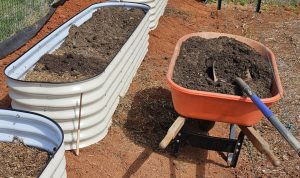
If you are ready to grow sweet potatoes, start by working in some good compost. If you do not have sandy soil, you’ll want to mound the soil where you expect to plant. This will help warm the soil more quickly, but it will also give the potatoes an easy place to grow, and help to provide good drainage. Plant the transplants (called slips) in rows 3 feet apart with 8 to 12 inches between plants in the row, at a depth of 3 to 4 inches. Water in transplants, and keep them well hydrated while they establish their roots.
Propagation
There are many ways to obtain slips. (Slips are basically a rooted stem of the sweet potato plant.) You can purchase them from a reputable source, but when you propagate your own, you’ll know exactly what you are getting. There are several ways to grow sweet potato slips.
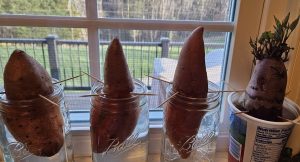
One way is to obtain sweet potatoes from a grocery store. The number will depend on how many plants you want to grow. Some grocery stores offer several varieties, which will allow you to experiment with something new. I suggest you purchase organic sweet potatoes. A local store that specializes in organic produce had 5 different varieties from which to choose. Pick potatoes with an obvious top and bottom. The top will be pointy, and the bottom will be flatter. Potatoes can produce more than 30 slips, but plan on 8-10 good, healthy slips from a single potato. To make the slips, wash the potato and push 4 toothpicks in the sides of the potato a little more than halfway down the potato. Place the potato in a jar of water. The bottom part of the potato should be well submerged. Let it sit in a sunny window. Don’t be discouraged. It could take a few weeks for them to begin sprouting. Some cultivars will sprout more quickly than others. Give them fresh water at least once a week. When the sprouts emerge, let them remain on the potato until they are a few inches long. Then, carefully pinch off the stem, allowing a little of the potato to come off with the stem. Place the stem in water and let it root. Surprisingly, they will begin to produce roots in a day or two. Continue until you have enough rooted stems (or slips) to plant in your prepared space.
Another way to propagate your own slips, is to purchase those same potatoes, but this time, slice the potato in half lengthwise. Place the potato, cut side down, in a tray filled with soil. Nestle it down firmly in the soil. Be sure to water it as needed. Once the sprouts emerge, follow the directions above to create the slips.
Additionally, there is a third method for obtaining slips. I prefer this method as it is the easiest. When I harvest my sweet potatoes, I save some of the healthiest vines from the sweet potato varieties I want to propagate. I prepare a large flower pot with soil and I plant the salvaged vines. Be sure there is a saucer because you will need to water it weekly. Also, as it grows you can contain it somewhat by curling the vine back into the pot. About two weeks before I am ready to plant the sweet potato slips, I cut the vine into sections. Cut just below the leaf node (where the leaf emerges from the stem) and remove that leaf from the stem. This is where the roots will emerge. Be sure to leave a leaf at the other end of the stem to help the slip photosynthesize. Place these cuts in water and watch the magic! Roots should appear in just a day or two. While this can be an easy way to produce slips, it does require caring for the potted plant from harvest time through approximately 2 weeks before planting time. It does take space to keep the pot in the house, but I find it well worth the time and space.
Varieties and Cultivars
If you choose to start your own slips from purchased potatoes, you will find a number of cultivars available. This past year, I grew 3 different cultivars. I grew the ever popular Beauregard, which is by far the most popular sweet potato in the US. It is somewhat uniform in shape and size, it is resistant to disease, and it’s credited with saving the sweet potato industry. The Beauregard has bright orange flesh, and is sweet and high in moisture content. It lends itself to a variety of dishes both sweet and savory. However, not much can beat a roasted Beauregard sweet potato with butter. I find it a valuable addition to curries, soups, and salads alike. Additionally, the leaves of the sweet potato vines are usually abundant, and completely edible. Look online for recipes.
Covington and Jewel are equally loved, orange-fleshed sweet potato cultivars that can replace Beauregard. In fact, there are many cultivars of orange-fleshed sweet potatoes. You can read about some of them here.
I also grew the cultivar Garnet. This is an interesting sweet potato with a reddish-purple skin and deep red-orange flesh. It is also sweet, but it has an earthy flavor that is more complex than other orange-fleshed sweet potatoes. I will be growing Beauregard and Garnet sweet potatoes again this year.
The third sweet potato cultivar I grew this past summer was a purple variety. There are a number of purple sweet potato varieties. The University of California notes these four varieties:
Stokes — These are purple on the outside and inside. These are dry and not very sweet. I grew this last year, and we didn’t love it. While it’s high in the antioxidant anthocyanin, I prefer to get mine from blueberries.
Okinawan — These are also known as Hawaiian sweet potatoes. They are beige on the outside and purple on the inside. Apparently, they are slightly creamier than Stokes. I have not seen this variety in the store where I buy my organic sweet potatoes.
Murasaki –– These are also known as Japanese sweet potatoes. They are Purple on the outside and creamy white on the inside. I purchased one of these for propagation. I’m excited to try it.
Ube –– Although UC lists this as a variety of sweet potato, they note that it is in actuality, a yam. Apparently, it’s brown on the outside and purple on the inside, and is used in desserts.
Additionally, there are white sweet potatoes, which are white both inside and out. There are several varieties or cultivars, however, there is not much literature available regarding white sweet potatoes. I’ll be growing some this year, but I don’t know what variety I chose from the store, as they are not labeled with cultivar or variety.
If you’d rather buy slips, check with reputable seed companies or organizations for the variety you desire.
Next Steps
Once you have chosen your varieties, propagated and planted your slips in your prepared bed, and they have begun to grow, what’s next?

Photo by Gena Breakiron
The sweet potato is a vine, and it can produce a lot of plant matter. You’ll want to keep these vines from attaching to the soil. At every leaf node there is a potential plant. The vines attempt to grow new plants all along the vines. Allowing this process will take energy away from the mother plant, resulting in inferior sweet potatoes. The answer is to visit your plants at least once a week, and pull the vines from the soil up to the mother plants. Then, be sure the sweet potatoes growing from the mother plants are well covered by soil.
Combating Pests and Diseases
Unfortunately, there are often systems working against your efforts. There are a few fungal diseases that can affect your plants, but most of the varieties or cultivars available today are developed to be resistant to fungal diseases. Nematodes, however, are microscopic, thread-like roundworms that live in some soils. They can cause root knots. which can cause damage to your sweet potatoes. You can read more about it from NC State, here.
The biggest adversaries I and many other gardeners face are voles or other rodents, and deer. Don’t worry if you have moles (they are not rodents!) because they eat grubs and worms. The voles, however, often use the mole tunnels for travel, and they eat roots! PMG’s Nancy Bolton wrote a great article about voles and moles which you can read here.
If you have deer, the only thing you can do to deter them is to erect a good fence. They will eat almost anything you plant. See Deer, Deer, Deer!
Harvesting and Curing
If you have been successful in growing sweet potatoes, you’ll need to harvest them. You can leave them in the ground until frost threatens. You could harvest them after a light frost, but if you choose to save the vines for next year, frost will damage the vines.

When digging the sweet potatoes, be sure to give a wide berth around the mother plant with your shovel. Dig deeply, but carefully. Brush the soil aside and remove the sweet potatoes. If your soil is rich with organic matter, it shouldn’t be too difficult to move most of the soil by hand. Set the sweet potatoes out and let them dry a bit. Remove large deposits of soil, but do not attempt to remove all the soil at this point. The skins are very tender, and you’ll risk damaging them. I place mine gently in large plant crates with lots of ventilation, and let them sit in the shade for a day or two to dry. This will allow the skins to dry and toughen up a bit. Then, I brush them gently to get most of the dirt off and put them back in the crate for storage. Don’t wash them until you’re ready to use them. Some gardeners lay them on paper on the basement floor. They need to be left in a warm, humid environment for a week or two to cure. Curing allows the starches to convert to natural sugars. This is what puts the “sweet” in sweet potatoes. Read more about curing sweet potatoes here.
Whatever you decide to grow, have fun with it. Learn as you go, and don’t hesitate to ask for advice. If you find me, or another vegetable gardener, you’ll likely find someone who loves to talk about vegetable gardening. Try something new every year. Most importantly, enjoy your time in the garden and your bounty on the table.
The Help Desk and The Garden Shed
Resources for your questions are the Help Desk and this newsletter. The Garden Shed is searchable by topic, so you can easily locate older articles. Look for “Search this Site” on our main page.
If you are having issues with your plants, you’ll want to submit a soil sample, or if you have questions about gardening, you can call or email the Master Gardener Help Desk, Piedmont Master Gardener Help Desk.
Featured photo: Gena Breakiron
SOURCES:
Piedmont Master Gardener Help Desk
Growing Sweet Potatoes-University of Maryland
VA Tech extension Home vegetable planting guide
Information about Yams-Britannica
Clemson Univ- Home and Garden info-sweet potato
NC State University Sweet Potato Varieties
University of California Purple Sweet Potatoes
PMG-The Garden SheNC State University – Curing Sweet Potatoes.
Penn State-Parasitic Nematodes Explained