Some of our most popular vegetables grow on vines. Pole beans, cucumbers, tomatoes, peas, and melons are a few examples. If allowed to sprawl unchecked, the vegetation can take up a lot of valuable gardening space. This is where vertical gardening methods come to the rescue.
So what is vertical gardening? The Virginia Cooperative Extension describes it as “the practice of ‘gardening up,’ in which a variety of structures are used to elevate plant growth to take advantage of vertical space.”
ADVANTAGES OF VERTICAL GARDENING
If you have a small vegetable garden plot, vertical gardening methods allow you to optimize the space available. Other benefits include:
- Producing a greater yield per square foot of growing space.
- Cleaner, higher quality produce. Vegetable foliage that has contact with the soil can be damaged by soil pathogens, slugs, worms or other creepy crawlies. Training the plant up onto a vertical support reduces or eliminates those issues.
- Better air movement through vegetable stems and foliage, which helps to reduce diseases.
- Easier detection of insect pests, which makes it easier to spray and dust them or pick them off by hand.
- Simplifies harvesting. Vertical gardening puts vegetables more at eye level and within easy reach, making it possible to harvest while standing rather than bending over. This is particularly beneficial for gardeners with physical limitations.
ASPECTS OF VERTICAL GARDENING METHODS TO CONSIDER
It’s easy to feel overwhelmed when choosing the right vertical support system for your garden. To help bring clarity to the decision-making process, keep the following in mind:
- Cost. Commercially available trellises and other support systems can be expensive, depending on the style of trellis and materials used. However, well-made vertical supports can last for years, which helps offset the initial investment. Also, “do it yourself” gardeners can save money by constructing their own trellises out of materials they may already have on hand or can easily obtain. For example, an old ladder can be propped up against a sunny wall and used to grow cucumbers. Peas and beans may be trained onto a chain link fence. Even pruned branches from shrubs and trees make useful vegetable supports (plus they are free).
- Sturdiness. A vertical support system doesn’t have to be fancy or expensive, but it does have to be sturdy enough to support the combined weight of the plant’s foliage and ripening vegetables without collapsing or toppling over.
- Training vines onto supports. Some vegetables, like pole beans, climb on their own and require little, if any, help from the gardener. Other vegetables (tomatoes in particular) must be tied or clipped with plant clips onto supports as the plant climbs toward the sun. This means monitoring them closely as they grow.
- Moisture Requirements. Vertically grown plants have greater exposure to sunlight and air, which means they may dry out faster and require more water. However, a drip watering system and a layer of mulch over the roots can help solve that problem.
- Position of vertical support in relation to nearby plants. Vertically supported plants may block sunlight and air from nearby lower-growing plants. While this might be a problem for most sun-loving vegetables, others, such as lettuce, kale and spinach, appreciate some shade, especially during hot afternoons.
- Up-front Planning. Decide what kind of vertical support you need, position it in the garden, anchor it into the soil, and make sure it is completely stable before you plant your vegetable crop. If you do this in reverse order, you run the risk of damaging your plants and their roots.
TYPES OF VERTICAL GARDENING SUPPORTS
Trellising, staking, and caging are the three most widely used methods for growing vegetables vertically.
Trellising. A trellis consists of vertical supports combined with some sort of lattice, garden mesh netting, or twine that helps plants to climb upward. Some examples of trellises include the following:
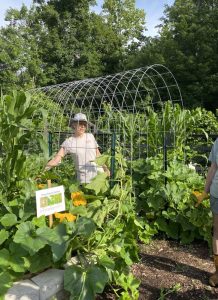
- Arch trellises are typically made out of steel, wrought iron, or galvanized cattle panels (heavy duty wire) bent into an inverted U shape. An arch trellis can be used to great advantage in vegetable gardens for growing vegetables with heavy fruits. The arch allows you to walk beneath it to harvest vegetables that are hanging down, such as squash, cucumbers, gourds, or even “personal size” melons and miniature pumpkins.

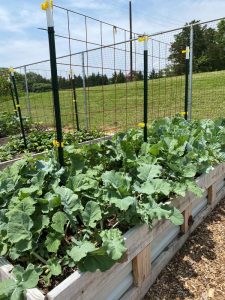
Vertical arch trellis growing beans and squash. Photo Credit: Fern Campbell - Panel trellises are flat structures that provide a sturdy surface for vegetables that grow vertically. A panel trellis is simply a box-like frame containing twine or garden mesh stretched from the top of the frame to the bottom of it for vegetables to climb onto. To construct a panel trellis, pound two 8’ wood fence posts or metal T-posts into the ground leaving 6’ of the posts above ground. Complete the box by joining the posts at the top and bottom with two cross beams made of 2’ x 4’ wood strips, bamboo poles, cedar poles, or heavy gauge wire. Securely staple, nail, or clip the twine, garden mesh or whatever material you’re using vertically from the top cross beam to the bottom one for the vegetables to climb onto. This type of trellis works well with vining vegetables because you can easily harvest from both sides of the trellis.

Vertical wire panel trellis. Photo Credit: Fern Campbell - Galvanized Cattle Panel Trellis. When anchored with sturdy T-posts, these galvanized steel panels can bear considerable weight. While they are useful for supporting cucumbers, peas or beans, they are also ideal for supporting heavier crops such as personal-size melons and pumpkins or gourds. As these heavier fruits develop, they may need additional support. If so, use strips of cloth or mesh netting to form a hammock or sling for the developing fruit. Make sure the strips are long enough to tie the sling to the trellis.
Staking. Depending on what crop you are growing, stakes may offer a simple, inexpensive way to grow certain crops vertically. For example:
- Single stakes are typically made of wood, bamboo or plastic-coated metal and are suitable for staking tomatoes or peppers. The stakes should be installed at the time the vegetables are planted and pounded firmly into the ground. If you wait until later to install the stakes, you run the risk of damaging the plant roots. TIP: Tomato and pepper plants tend to bend over at the base due to the weight of the fruit. To keep this from happening, use sisal twine to loosely tie the tomato seedling to the stake about 6 inches above the soil. As the plant grows upward, continue tying it to the stake every 6 to 12 inches.
- Teepee, tripod or pyramid style supports can be made of a wide variety of materials, including bamboo, cedar or other wood stakes, metal conduit, or even PVC. For teepee or tripod supports, the stakes should be pounded at an angle about a foot into the ground and bound together at the top to stabilize the structure. Depending on the crop, three stakes may be adequate, but four or more stakes will assure greater stability. A pyramid style support (also called a tuteur) has four legs for stability.
- Florida Weave, a stake and weave method, is used for growing vining crops in rows. Primarily used for tomatoes, this method also supports pepper plants. Installation consists of pounding sturdy wood stakes or metal T-posts into the soil at either end of the row, positioning additional stakes after every two plants within the row and then weaving jute or other twine among the plants and stakes to hold the plants upright. In her book Grow Great Vegetables in Virginia, author Ira Wallace provides detailed instructions for Florida string weaving. Better yet, see this YouTube video on the Florida Weave.
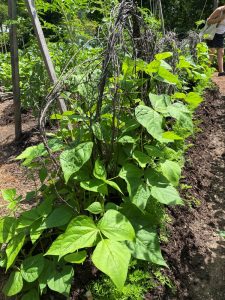
- Twigs make good supports for peas or other lower-growing vegetables such as bush beans that might tend to sprawl. Stick them in the soil next to the plants so that the vines can scramble up over them. The twigs need to be about 4 feet long or possibly longer, depending on the variety of peas or beans you’re growing. TIP: Don’t use willow twigs as vegetable supports. They will take root and sprout!
Twigs formed into vertical bean trellis. Photo Credit: Fern Campbell
Caging. Cages are appropriate for bushy vegetable plants or plants that have lateral branches such as tomatoes.
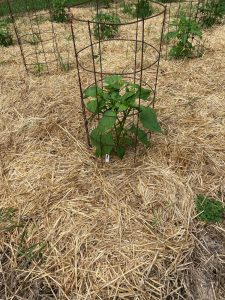
- Wire Conical Cages measure about 4 to 5 feet tall and are wide at the top and narrow at the bottom. These are suitable for supporting vegetables such as determinate (bush type) and dwarf tomato varieties, peppers and eggplants that grow no higher than the top of the cage. These cages are not suitable for growing taller or heavier plants where the weight of the foliage and fruits can cause the cage to topple over.
Peppers growing in conical wire cages. Photo Credit: Fern Campbell - Heavy-duty, tall tomato cages are available in a variety of designs and are made from powder-coated steel or heavy-duty plastic materials. They are designed to support indeterminate (vine-type) tomato varieties. Some of these cages are square rather than round and fold flat for easy storage.
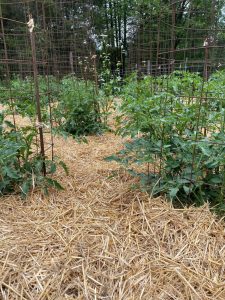
- Cement-reinforcing wire mesh comes in rolls and is perfect for corralling indeterminate tomato plants. With the aid of heavy-duty wire cutters or bolt cutters, the DIY gardener can fashion the mesh into sturdy cages that will last for years. Inserting two 1-inch wood stakes or rebar within each cage provides greater stability and helps it withstand strong wind gusts. In addition to supporting heavy indeterminate tomato crops, the wire has large openings that allow easy access within the plants for harvesting purposes.
Tomatoes growing in reinforced wire cages. Photo Credit: Fern Campbell
Additional Vertical Growing Methods
- Garden netting, a mesh-type product, is an inexpensive way to grow vines in conjunction with some of the trellising methods described above. It comes in rolls and can be hung from a sturdy cross bar so that vining vegetables can climb up it. The netting is available in a variety of widths and lengths. For example, fine mesh netting is suitable for protecting crops from birds, deer, or other animals. But to support vegetables, use a larger grid mesh with holes large enough (usually 4” square) to allow easy access for harvesting purposes.
- Companion planting is not normally thought of as a vertical gardening method, but it can be when you consider the “three sisters” concept of gardening. In this scenario, squash, beans, and corn are planted together in a “symbiotic” trio. Instead of sprawling across the soil, the beans climb up onto the corn stalks for support.
SUMMARY
Vertical gardening using trellises, stakes or cages is an efficient and practical way to grow vine-type vegetable varieties. However, some upfront planning is required to match the trellising method to the plant’s natural climbing tendencies. Countless vertical gardening supports are available for purchase, but a lot can be crafted by the home gardener using whatever materials are at hand.
FEATURED PHOTO: Pea vines on vertical trellis. Photo Credit: Fern Campbell
SOURCES
Edible Landscaping (Creasy, Rosalind, 2010)
Epic Tomatoes (LeHoullier, Craig, 2015)
Grow Great Vegetables in Virginia (Wallace, Ira, 2020)
New Vegetable Garden Techniques (Russell, Joyce, 2019)
The Garden Primer (Damrosch, Barbara, 2008)
Vertical Gardening (Fell, Derek, 2011)
Intensive Vegetable Gardening, Virginia Cooperative Extension Publication 426-335 by Professor Alex X. Niemiera, Virginia Tech 2023
Vertical Gardening Using Trellises, Stakes, and Cages, VCE Publication HORT-189NP by Katie Settlage, Virginia Tech 2014
Vertical Gardening Makes the Most of a Small Garden Footprint, University of Nebraska Extension – Lincoln, May 2019