Wavyleaf grass. Photo: Kerrie L. Kyde, Md. Dept. of Natural Resources, budwood.org
Keep an eye out for wavyleaf grass!!! Sadly, this invader is spreading, much like stiltgrass, and the public is asked to report sightings in our area. The PRISM Fact Sheet on this plant is well worth reading. As it explains,
“This perennial grass thickly blankets the ground and forms continuous carpets in short order. Wildlife scientists are concerned that wavyleaf’s rapid growth and dense roots and foliage have the potential to smother wildflowers, ferns, and other ground-layer plants, and to prevent forest regeneration in intact forests like what is happening with Japanese stiltgrass.”
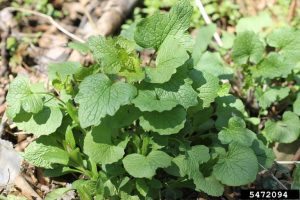
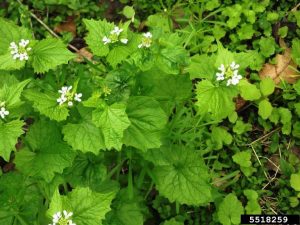
Garlic mustard (before flowering).. Photo: Rob Routledge, Sault College, Bugwood.orgGarlic mustard in flower. Photo: Richard Gardner, Bugwood.org
Garlic mustard is popping up in my garden beds and nearby woods. — and probably yours, too! It’s quite easy to pull up, so pull it now before it develops flowers and seeds, as in the photo at right.
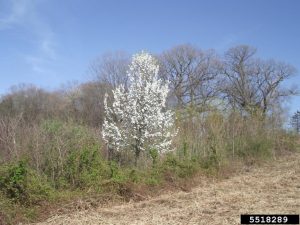
Callery or Bradford Pear (Pyrus calleryana ‘Bradford’) Callery pears are still in bloom as we go to press. For guidance in identification, here’s a tip from the very helpful Blue Ridge PRISM Fact Sheet,
Callery pear. Photo: Richard Gardner, Bugwood.org
“The only very early-blooming, white-
flowered trees that blossom at the same
time as ornamental pears and are likely
to be found in hedgerows and fields are native plums. . . . Both American plum (Prunus ameri- cana) and Chickasaw plum (Prunus angustifolia) are thorny, like
pears, but are shrubby and twiggy, unlike single-trunked pears.”
If you find one on your property, you may want to mark it now, since most eradication methods will have to be applied later in the year. For detailed advice on effective control methods, see Blue Ridge PRISM Fact Sheet, Callery or Bradford Pear.
SOURCES:
Featured Photo: Wavyleaf grass by Rebekah D. Wallace, University of GA, Bugwood.org