I have been feeling a little pot-bound. A few years ago, children mostly out of the house, I downsized to a smaller home and lot. After living here for over three years, I now realize I downsized too much, and, if I plan to live here until the bitter end, I need a first-floor owner’s suite to avoid breaking my neck climbing stairs every day. Because I had thought an addition might be necessary, I had also avoided adding an extensive garden. Once I made the addition decision, I hoped to be able to create something I really love after construction is complete.
The process of an addition began in July 2025, and, I am told, construction will actually begin next week. My biggest concern, other than the whole house falling down, has been the preservation of some portions of my existing garden. It is far from perfect, but I spend a good deal of time there, and knew I would need to plan well if some plants — those directly in the area workers will need to use — are to survive.
During the planning stage, I considered what I like about my current yard and garden, how it is used for me and my dogs, and what I do not like or want to change. Before creating a plan – which is still in progress – I made a wish list with my overall “wants” — including plants and structures I want to add, what I want to eliminate, and things that must be moved, temporarily or permanently, and protected during construction.
Protecting and Moving What I Want to Keep
Through the years, I have found that many plants are much more resilient than we might think. Although the beastly days of summer may not be the best time to transplant, and winter is generally for resting, circumstances sometimes dictate timing. Fortunately for my garden, construction is not due to start until late March, a good time to move some things around, but I did my research to make sure the plants I needed to move had the best chance for survival. The sources at the end of this article are a good starting point if you are considering transplanting any of your own plants.
Rose
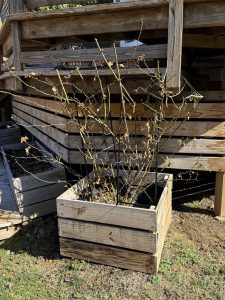
In 2024, I purchased a Madam Dubost rose, Rosa ‘Madame Dubost’, a fragrant, repeat-blooming, pink, Bourbon rose. I don’t have many roses because I find they require a little more attention (specifically pruning) than I usually like to devote to one plant. But I do love the smell of a blooming rose and these blooms smell SO good.
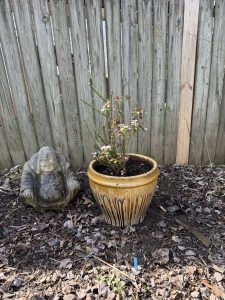
As it happens, late winter/early spring, when the rose is dormant, is a good time to both prune and move a rose and will cause less stress. In late February, I gave Madame a hard pruning, removing damaged and thicker canes as well as those that drastically crossed the center to allow for good air circulation. She was a mess due to neglect last fall and looked so much better after her trim. The remaining canes were pruned back just above an outward facing bud to 12 to 18 inches from the ground.
In mid-March, I watered Madame thoroughly a week before the move and again the day before. This made digging easier and assured good hydration. Working carefully, I dug around the plant, keeping as much of the roots and soil as possible while assuring the root ball would fit into the large pot which would be its temporary home. This did not go as well as I hoped, but I did the best I could. I then moved Madame, ensconced in her pot, to a place in the garden that gets partial sun and away from the construction area. I will need to make sure the rose stays hydrated, especially as summer approaches.
Japanese maples
I do love Japanese maples. The shape and color provide interest in the garden throughout the year, and there are so many varieties and sizes. The smaller varieties also partially satisfy my fascination with bonsai, which I have successfully tortured and killed for decades. (I do have one very special bonsai, a gift from a client, which I have managed to keep alive for several years. It seems to be doing well, thanks to the guidance of a fellow Master Gardener and bonsai whisperer.)
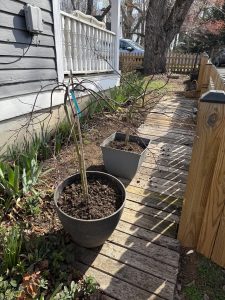
The trees in need of temporary homes are an Orangeola (Acer palmatum ‘Orangeola’) and a Garnet (Acer palmatum ‘Garnet’). Each is a slow-growing, weeping laceleaf. The Orangeola, left unpruned, could reach 6 feet or more when fully mature and the Garnet 6 to 9 feet. Because they are each about 3 feet tall and were planted in their current locations only last year, moving should be less stressful on the trees because their root systems are not maturely developed.
As with Madame, I pruned them in late February. This pruning was less drastic than the rose, however, and I removed only branches which were damaged and which did not contribute to the shape I ultimately wanted. I also watered thoroughly the day before moving. The rest of the process was the same as with the rose – digging around each tree to preserve roots and soil, planting each in a separate pot, and moving to a safe location.
Perennials
The remaining plants in need of new homes are perennials which I wanted to keep and relocate either permanently or temporarily. Although fall planting allows more time for a plant to become established before spring growth and the hot weather of summer, early spring is also a good time; and it was the time dictated by the construction process.
The plants I wanted to save include Autumn Joy Sedum (Hylotelephium spectabile ‘Autumn Joy’) from my previous home, ferns and hostas (specific varieties unknown) which came with the house and garden, as well as spiderwort (Tradescantia virginiana), cranesbill geranium (Geranium macrorrhizum), and a few others. None were particularly expensive or dear, but the recycler in me wanted to save what I could.
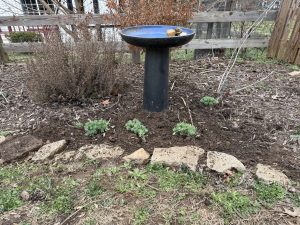
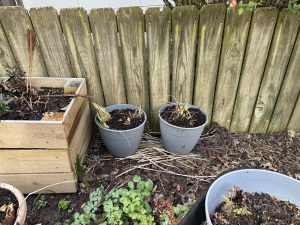
The perennials were all relocated in the same manner. Before digging up the plants, I prepared new locations – either in a planter or the garden – by loosening the soil well and creating a hole that was the same depth as the root ball, so the crown would be even with the surface of the soil, and about twice as wide. I moved the plants directly into the prepared areas, filled in and firmed the soil around each plant, and watered well.
Rather than temporarily relocate the sedum, spiderwort, and geranium, I transplanted most of them to other areas of the garden where I think they will do nicely. Because spring growth had already emerged, I kept more soil around the roots than I might have done in the fall.
The ferns and hostas had not yet emerged, and I located them based on memory and the dead fronds and leaves from last year. These plants are shade-loving and there is only one good area for them in my yard: along a fence on the south side of the lot with ample shade provided by my neighbor’s house. To accommodate them, I temporarily relocated a long wooden planter next to the fence in a location my builder assured me would be safe. Because these plants did not yet have spring growth – and because I was doing a lot of guesswork as to what I was digging up – I did not keep as much soil around the roots as I did with the sedum.
Repeat After Me: Everything Will Be Fine
Construction usually seems to include a fair amount of deconstruction, and building on a small lot adds mess and destruction all around – there will be equipment, tools, supplies, and workers everywhere. My builder is sensitive to my concerns that certain areas of the garden be protected. Nevertheless, I know there will come a time when the entire yard is a mess, and I will want to run away and forget it all. This is when I will remind myself to breathe. I have yet to encounter a home project in which things did not look substantially worse before looking better.
Finally, in the event you are planning a renovation or other work on your house, below are links to several useful articles about protecting your landscaping and preserving topsoil.
Featured Image: “Damage from a microburst on N. Glebe Road, Arlington, Va., 3 July 2010” by Alan Kotok is licensed under CC BY 2.0.
.jpg)
SOURCES:
Nashville Rose Society, “Transplanting and Moving Rose Bushes”
https://www.nashvillerosesociety.org/transplanting-and-moving-rose-bushes/
Chicago Botanic Garden, “Pruning Mature Roses?”
https://www.chicagobotanic.org/plant-information/smart-gardener/pruning-mature-roses
Toronto Master Gardeners, Transplanting a Japanese Maple
https://www.torontomastergardeners.ca/askagardener/transplanting-a-japanese-maple/
Clemson Cooperative Extension, Growing Perennials
https://hgic.clemson.edu/factsheet/growing-perennials/
Protecting Gardens During Renovation
https://exclusives.mgcafe.uky.edu/2021/hort/protect-your-plants-during-home-renovations
https://thurstoncd.com/wp-content/uploads/2020/05/TAM-3_Tree-Protection-During-Construction-4.20.pdf
https://laidbackgardener.blog/2019/09/10/renovate-without-destroying-your-garden/